The Church joyfully awaits the twofold comingof her Redeemer (Collect), who “saves His people from their sins” (Gospel) and who is the Shepherd of Israel (Gradual) that is the Church, of whom all are members who have faith in Jesus Christ. Thus Isaias foretells that “all flesh shall see the salvation of God” and St. Paul adds that he has been chosen to be the Apostle of the Gospel, “for obedience to the faith in all nations for His name.” With the help of today’s Mass, we may prepare to celebrate the anniversary of the “adorable birthday” of the only-begotten Son of God (Secret and Postcommunion), the son of David, whom the spouse of Joseph brought into the world (Gospel) and who, “born as man” according to the seed of David, has by His Resurrection proved, beyond all question, that He was God (Epistle). Thus the birth of Christ is already set before us as pointing through His Passion to His resurrection and reign in glory. It is a twofold coming, or, more accurately, two instants of the same coming: our Redeemer’s birth is a preparation for His final return as Judge and Victor. Most of the liturgical texts of Christmastide are to be understood in this sense; as we contemplate the lowliness of Bethlehem we are already given to sing of his coming in glory and on the dawn of his birth we greet redemption fulfilled. The Mass of the vigil is especially striking in this respect; the same thought recurs in nearly every part of it. It will be seen, then, why St. Bernard comments at length on the Hodie (today) and the Mane (tomorrow) of Exodus (Introit and Gradual) and sees in them “present life which is short and gloomy and eternity amid the glory of the saints.” We should prepare ourselves, therefore, to receive Him with joy as our Redeemer so that we “may also without fear behold Him coming as our Judge” (Collect). (Ex. 16:6-7) This day you shall know that the Lord will come, and save us: and in the morning you shall see His glory. (Ps. 23:1)_. The earth is the Lord's and the fullness thereof, the world, and all they that dwell therein. Gloria Patri. O God, who makest us glad with the yearly expectation of our redemption, grant that we who now joyfully receive Thine only-begotten Son as our Redeemer, may also without fear behold Him coming as our Judge, the same our Lord Jesus Christ Thy Son: Who lives and reigns with Thee in the unity of the Holy Spirit, God, forever and ever. Lesson of the Epistle of Saint Paul the Apostle to the Romans (1:1-6) (Ex. 16:6-7) This day you shall know that the Lord will come and save us: and in the morning you shall see His glory. ℣. (Ps. 79:2-3) Give ear, O Thou that rulest Israel: Thou that leadest Joseph like a sheep, Thou that sittest upon the Cherubim, shine forth before Ephraim, Benjamin, and Manasses. The Sequel of the holy Gospel according to saint Matthew (1:18-21). Saint Andrew Daily Missal with Vespers for Sundays and Feasts, by Dom Gaspar Lefebvre, O.S.B. of the Abbey of St. André, 1953Vigil of the Nativity of Our Lord
Reflexions on the Liturgy of the Day
Liturgy of the Mass
Introit
“The Church,” says St. Bernard, “inspired by almighty God has put these words in today’s office, whence they acquire a strength of meaning corresponding to the distance between symbol and reality and between light and shade.”
“It was all the more fitting,” says St. Gregory, “that the Lord should have been born at Bethlehem, since Bethlehem means ‘house of bread’; for it was He who said: I am the living bread which came down from heaven.” “The place where the Lord was born was of old called ‘house of bread’, because it was there, that He was to appear in the flesh, who one day would fully satisfy the souls of His elect” (Matins). Collect
Epistle
Paul, a servant of Jesus Christ, called to be an Apostle, separated unto the Gospel of God, which He had promised before by His prophets in the holy Scriptures concerning His Son, who was made to Him of the seed of David according to the flesh: who was predestinated the Son of God in power according to the spirit of sanctification by the resurrection of our Lord Jesus Christ from the dead: by whom we have received grace, and apostleship for obedience to the faith in all nations for His name, among whom are you also the called of Jesus Christ our Lord.Gradual
Alleluia, Alleluia. ℣. Tomorrow shall the iniquity of the earth be abolished: and the Saviour of the world shall reign over us. Alléluia.Gospel
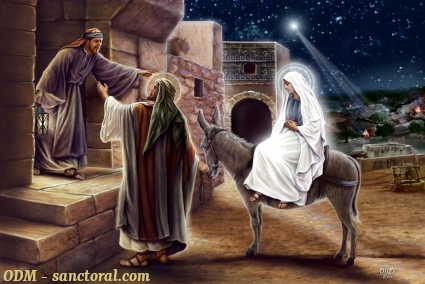
Then Mary the Mother of Jesus was espoused to Joseph, before they came together, She was found with child of the Holy Spirit. Whereupon Joseph Her husband, being a just man and not willing publicly to expose Her, was minded to put Her away privately. But while he thought on these things, behold the Angel of the Lord appeared to him in his sleep, saying: Joseph, son of David, fear not to take unto thee Mary thy wife: for that which is conceived in Her is of the Holy Spirit. And She shall bring forth a Son, and thou shalt call His name Jesus: for He shall save His people from their sins.
The Liturgical Year, authored by Dom Prosper Gueranger (1841-1875)