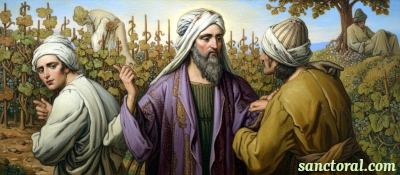
The lessons and responsories in the night office are taken during the whole week from the book of Genesis; they relate the story of the creation of the world and of man, of our first parent’s fall and the promise of a Redeemer, followed by the murder of Abel and Noah’s genealogy back to Adam. “In the beginning,” reads the Scripture, “God created heaven and earth, and upon the earth He made man... and He placed him in a garden of paradise to be mindful of it and tend it.” St. Gregory points out that Christ compared the kingdom of heaven to a householder who hired labourers to cultivate his vineyard. “Who could be more properly represented by the head of a household than our Creator who governs aU creatures by His Providence and, just as a master has servants in his house, has His chosen ones in this world? His vineyard is His Church. All those who in the uprightness of their faith have set themselves, and urged others, to do good are the labourers in this vineyard. Those of the first hour together with those of the third, the sixth and the ninth, are the people of the Hebrews who, from the beginning of the world, striving in the person of their saints to serve God with a right faith, ceased not, so to say, to work at the cultivation of the vineyard. But at the eleventh hour the Gentiles are called, and to them are spoken the words: “Why stand ye here all the day idle?” (3rd nocturn, Matins). Thus all men are called to workin the Lord’s vineyard, by sanctifying themselves and their neighbour, thereby glorifying God he earth in thy work; with labour and toil shalt thou eat thereof all the days of thy life... In the sweat of thy face shalt thou eat bread till thou return to the earth out of which thou wast taken.” “After his sin the first man was exiled from Eden,” St. Augustine explains, “and involved all his descendants in the penalty of death and reprobation since they were corrupted in the person of him from whom they sprang. The whole mass of condemned humanity was thus plunged in misery, or rather, found itself in bondage and immersed in all sorts of evil ” (2nd Nocturn). To-day’s Mass contains the same thoughts. “The sorrows of death surrounded me,” runs the Introit; “we are justly afflicted for our sins,” adds the Collect; in the Epistle St. Paul depicts Christian life as an arena where a man, to carry off the prize, must take pains and strive for the mastery. The reward of eternal life, the Gospel teaches us, is given only to those who work in God’s vineyard, and since sin entered in the world, work there is laborious and hard. This Septuagesima Mass, studied in this way in the light of Adam’s fall, prepares us to begin this new period of the liturgical year and helps us to understand the sublimity of the Paschal mystery for which this season is a preparation. We should now have a clearer idea of all that Easter means and what the Church intends to remind us of when she tells us that God “who created man in a wonderful manner, more wonderfully redeemed him” (Holy Saturday: Collect after 1st Prophecy) and that “the creation of the world in the beginning was not a more excellent thing than the immolation of Christ our Passover in the fullness of time” (Holy Saturday: Collect after 9th Prophecy). (Ps. 17:5-7) The terrors of death surged round me, the cords of the nether world enmeshed me. In my distress I called upon the Lord; from His holy temple He heard my voice. (Ps. 17:2-3) I love You, O Lord, my strength, O Lord, my rock, my fortress, my deliverer. Gloria Patri. O Lord, we beseech You, graciously hear the prayers of Your people, that we who are justly punished for our sins may be mercifully delivered for the glory of Your name. Through our Lord… Lesson of the Epistle of Saint Paul the Apostle to the Corinthians (I Cor. 9:24-27; 10:1-5) (Ps. 9:10-11; 9:19-20) A helper in due time in tribulation. Let them trust in thee who know thy name: for thou hast not forsaken them that seek thee, O Lord. ℣. For the poor man shall not be forgotten to the end: the patience of the poor shall not perish for ever. Arise, O Lord, let not man be strengthened. (Ps. 129:1-4) Out of the depths I cry to You, O Lord; Lord, hear my voice! ℣. Let Your ears be attentive to the prayer of Your servant. ℣. If You, O Lord, mark iniquities, Lord, who can stand it? ℣. But with You is forgiveness, and by reason of Your law I have waited for You, O Lord. The Sequel of the holy Gospel according to saint Matthew (20:1-16). Sources: Daily Traditional Latin Mass Readings, 1962Septuagesima Sunday
Reflexions on the Liturgy of the Day
Liturgy of the Mass
Introit
Collect
Epistle
Brethren: Know you not that they that run in the race, all run indeed, but one receiveth the prize? So run that you may obtain. And everyone that striveth for the mastery refraineth himself from all things: and they indeed that they may receive a corruptible crown; but we an incorruptible one. I therefore so run, not as at an uncertainty; I so fight, not as one beating the air; but I chastise my body, and bring it into subjection, lest perhaps when I have preached to others, I myself should become a castaway. For I would not have you ignorant, brethren, that our fathers were all under the cloud, and all passed through the sea, and all in Moses were baptized, in the cloud and in the sea: and did all eat the same spiritual food, and all drank the same spiritual drink: (and they drank of the spiritual rock that followed them: and the rock was Christ). But with most of them God was not well pleased.Gradual
Tract
Gospel
At that time Jesus spoke to his disciples this parable: The kingdom of heaven is like to an householder who went out early in the morning to hire laborers into his vineyard. And having agreed with the laborers for a penny a day, he sent them into his vineyard. And going out about the third hour, he saw others standing in the market place idle, and he said to them: Go you also into my vineyard, and I will give you what shall be just. And they went their way. And again he went out about the sixth and the ninth hour: and did in like manner. But about the eleventh hour he went out and found others standing, and he said to them: Why stand you here all the day idle? They say to him: Because no man has hired us. He said to them: Go you also into my vineyard. And when evening was come, the lord of the vineyard said to his steward: Call the laborers and pay them their hire, beginning from the last even to the first. When therefore they were come that came about the eleventh hour, they received every man a penny. But when the first also came, they thought that they should receive more: and they also received every man a penny. And receiving it they murmured against the master of the house, saying: These last have worked but one hour, and thou hast made them equal to us that have borne the burden of the day and the heats. But he answering said to one of them: Friend, I do thee no wrong: did thou not agree with me for a penny? Take what is thine and go thy way: I will also give to this last even as to thee. Or, is it not lawful for me to do what I will? Is thy eye evil, because I am good? So shall the last be first, and the first last. For many are called, but few chosen.
Saint Andrew Daily Missal with Vespers for Sundays and Feasts, by Dom Gaspar Lefebvre, O.S.B. of the Abbey of St. André, 1953)