For forty days and forty nights rain fell on the earth, while the ark floated on the waters which rose above the mountain tops and covered them; and in this whirlpool all men were carried away “like stubble” (Gradual); only Noe and his companions in the ark remaining alive. Then God remembered them and at length the rain ceased. After some time, Noe opened the window of the ark and set free a dove, which returned with a fresh olive leaf and Noe understood that the waters no longer covered the earth. And God told him,“Go out of the ark... go ye upon the earth, increase and multiply...” And the rainbow appeared as a sign of reconciliation between God and mena. That his story is related to the Paschal mystery is shown by the fact that the Church reads it on Holy Saturday; and this is how she herself applies it, in the Liturgy, to our Lord and His Church. “The just wrath of the Creator drowned the guilty world in the vengeful waters of the flood, only Noe being saved in the ark. But then the admirable power of love laved the world in blood.” It was the wood of the ark which saved the human race and it is that of the Cross which in its turn, saves the world. “Thou alone,” says the Church, speaking of the Cross, “hast been found worthy to be, for this shipwrecked world, the ark which brings safely into port.” “The open door in the side of the ark by which those enter who are to escape from the flood, and who represent the Church, are, as the liturgy explains, a type of the mystery of redemption; for from our Lord’s wounded side flowed blood and water, symbols of the Eucharist and baptisma. “O God, who by water didst wash away the crimes of the guilty world, and by the overflowing of the deluge didst give a figure of regeneration, that one and the same element might in a mystery be the end of vice and the origin of virtue: look, O Lord, on the face of Thy Church and multiply in her Thy regenerations, opening the fonts of baptism all over the world to make new the Gentiles.” “In the days of Noe,” says St. Peter, “eight souls were saved by water, whereunto baptism being of the like form, now saveth you also.” On Maundy Thursday when the bishop blesses the oil, obtained from the fruit of the olive-tree, which is to be used for the sacraments, he says: “When of old the crimes of the world were atoned forbythewatersofthe flood a dove, foreshadowing the gift to come, announced by an olive-branch the return of peace to the earth. And this is made clear by events in later times: when the waters of baptism have washed away all guilt of sin the unction of the oil makes us joyous and at peace.” Now Christ, far more than Noe, was the second Adam, peopling the world with a race of believing souls, faithful to God. On Holy Saturday, in the Collect following the second prophecy, which relates the story of Noah, the Church humbly asks God to “effect peacefully” by His eternal decree, the “work of human salvation” and “to let the whole world experience and see that what was fallen is raised up, what was old is made new,” and that “all things are re-established through Him from whom they received their first being, Jesus Christ our Lord.” “Through the Church’s neophytes,” says the Easter liturgy, “the earth is renewed, and thus renewed she brings forth fruit as it were from the dead ’.” (Ps. 43:23-26) Arise, why sleepest Thou, O Lord? arise, and cast us not off to the end. Why turnest Thou Thy face away, and forgettest our trouble? our belly hath cleaved to the earth: arise, O Lord, help us and deliver us. (Ps. 43:2) We have heard, O God, with our ears: our fathers have declared to us. Gloria Patri. O God, who seest that we put not our trust in any thing that we do: mercifully grant that by the protection of the Doctor of the Gentiles we may be defended against all adversities. Through our Lord Jesus Christ, Thy Son, Who lives and reigns with Thee in the unity of the Holy Spirit, God, forever and ever. Lesson of the Epistle of Saint Paul the Apostle to the Corinthians (II Cor. 11:19-33; 12:1-9) (Ps. 82:19, 14) Let the Gentiles know that God is Thy Name: Thou alone art the Most High over all the earth. ℣. O my God, make them like a wheel, and as stubble before the wind. (Ps. 59:4, 6) Thou hast moved the earth, O Lord, and hast troubled it. Heal Thou the breaches thereof, for it has been moved. That they may flee from before the bow: that Thine elect may be delivered. The Sequel of the holy Gospel according to saint Luke (8:4-15). Sources: Daily Traditional Latin Mass Readings, 1962Sexagesima Sunday
Reflexions on the Liturgy of the Day
In his divinely appointed mission, as father of all generations to come, Noe is principally a figure of Christ5; he was truly the second father of the human race and he is the symbol of life renewed. The liturgy tells us that the olive-branch, by its foliage, is asymbolofthe blessed fertility bestowed by almighty God upon Noe when he came forth from the ark, which St. Ambrose calls in to-day’s Office the “seminarium,” that is, the nursery or the place containing the seed of life which is to fill the world.
In the beginning it was through the Word that God made the world (Last Gospel) and through preaching of His Gospel our Lord, the Word of God, came to bring men to new birth. “Being born again,” says St Peter, “not of corruptible seed, but incorruptible, by the word of God who liveth and reigneth for ever. And this is the word which by the Gospel hath been preached unto you.” In the light of these lofty thoughts we can see how the parable of the sower read in to-day’s Gospel stands out as particularly apt. In Noe’s days men perished, St Paul tells us, because of their unbelief whereas it was Noe’s faith that “framed the ark” and saved him; likewise those alone who believe the words of Jesus and keep them will be saved. In to-day’s Epistle St. Paul recounts all he did and suffered to spread the faith among the nations. Liturgy of the Mass
Introit
Collect
Epistle
Brethren, You gladly suffer the foolish: whereas yourselves are wise. For you suffer if a man bring you into bondage, if a man devour you, if a man take from you, if a man be lifted up, if a man strike you on the face. I speak according to dishonor, as if we had been weak in the past. Wherein if any man dare (I speak foolishly), I dare also. They are Hebrews, so am I. They are Israelites, so am I. They are the seed of Abraham, so am I. They are the ministers of Christ (I speak as one less wise), I am more: in many more labors, in prisons more frequently, in stripes above measure, in deaths often. Of the Jews five times did I receive forty stripes save one. Thrice was I beaten with rods, once I was stoned, thrice I suffered shipwreck, a night and a day I was in the depth of the sea: in journeying often, in perils of waters, in perils of robbers, in perils from my own nation, in perils from the Gentiles, in perils in the city, in perils in the wilderness, in perils in the sea, in perils from false brethren: in labor and painfulness, in much watching, in hunger and thirst, in fastings often, in cold and nakedness; besides those things which are without, my daily instance, the solicitude for all the Churches. Who is weak, and I am not weak? who is scandalized, and I am not on fire? If I must needs glory, I will glory of the things that concern my infirmity. The God and Father of Our Lord Jesus Christ, who is blessed for ever, knoweth that I lie not. At Damascus the governor of the nation under Aretas, the king, guarded the city of the Damascenes to apprehend me: and through a window in a basket was I let down by the wall, and so escaped his hands. If I must glory (it is not expedient indeed) but I will come to visions and revelations of the Lord. I know a man in Christ above fourteen years ago, whether in the body I know not, or out of the body, I know not, God knoweth, such a one caught up to the third heaven. And I know such a man, whether in the body or out of the body, I know not, God knoweth: that he was caught up unto paradise, and heard secret words which it is not granted to man to utter. For such a one I will glory: but for myself I will glory nothing but in my infirmities. For though I should have a mind to glory, I shall not be foolish: for I will say the truth: but I forbear, lest any man should think of me above that which he seeth in me, or anything he heareth from me. And lest the greatness of the revelations should exalt me, there was given me a sting of my flesh, an angel of Satan, to buffet me. For which thing, thrice I besought the Lord that it might depart from me. And He said to me: my grace is sufficient for thee: for power is made perfect in infirmity. Gladly therefore will I glory in my infirmities, that the power of Christ may dwell in me.Gradual
Tract
Gospel
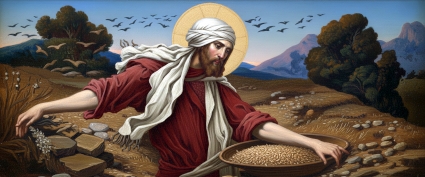
At that time, when a very great multitude was gathered together and hastened out of the cities unto Jesus, He spoke by a similitude: The sower went out to sow his seed: and as he sowed, some fell by the wayside, and it was trodden down, and the fowls of the air devoured it. And other some fell upon a rock: and as soon as it was sprung up, it withered away, because it had no moisture. And other some fell among thorns, and the thorns growing up with it choked it. And other some fell upon good ground: and being sprung up yielded fruit a hundredfold. Saying these things, He cried out: He that hath ears to hear, let him hear. And His disciples asked Him what this parable might be. To whom He said: To you it is given to know the mystery of the kingdom of God, but to the rest in parables: that seeing they may not see, and hearing may not understand. Now the parable is this. The seed is the word of God. And they by the wayside are they that hear: then the devil cometh and taketh the word out of their heart, lest believing they should be saved. Now they upon the rock are they who, when they hear, receive the word with joy; and these have no roots: for they believe for a while, and in time of temptation they fall away. And that which fell away among thorns are they who have heard and, going their way, are choked with the cares and riches and pleasures of this life, and yield no fruit. But on the good ground are they who in a good and perfect heart, hearing the word, keep it, and bring forth fruit in patience.
Saint Andrew Daily Missal with Vespers for Sundays and Feasts, by Dom Gaspar Lefebvre, O.S.B. of the Abbey of St. André, 1953)