It is the voice of Isaias that the Church bids us listen to in the Introit, that St. Paul echoes in the Epistle, that our Lord refers to in the Gospel. These references are to emphasize that the prophet’s predictions were accomplished at the coming of the Messias. But Isaias pervades the whole of the Advent liturgy, and some portion of his prophecy is read everyday at Matins; the lessons at the Ember Saturday Mass are taken from the same source, and on Christmas night it is in the words of Isaias that Jerusalem (the Church) enlarged to embrace the whole earth celebrates her joy in Emmanuel born of a virgin, and the divine greatness of the Prince of Peace. (Is. 30:30) People of Sion, behold the Lord shall come to save the nations: and the Lord shall make the glory of His voice to be heard, in the joy of your heart. Psalm. Give ear, O Thou that rulest Israel: Thou that leadest Joseph like a sheep. Gloria Patri. Stir up our hearts, O Lord, to prepare the ways of Thine only-begotten Son; that through His coming we may attain to serve Thee with purified minds. Who with Thee liveth and reigneth... Lesson of the Epistle of Saint Paul the Apostle to the Romans (15:4-13) Here, Christians, is your instruction; be patient, be firm in hope, and you shall delight in the God of peace who is coming to you. But take heed, you must have cordial charity one for the other; it is the mark of the children of God. The prophet tells us that the Messias will make even wolf and lamb dwell together; and now we have the Apostle showing us how this same Christ brings Jews and Gentiles into the one same family. Glory to this sovereign King, the powerful offspring of the root of Jesse, who now bids us hope in him! Listen to the Church, she again tells us that he is about to show himself in Jerusalem. Thou art He that was to come, O Jesus! We look for no other. We were blind, thou hast enlightened us; we were lame, thou hast made us walk; the leprosy of sin disfigured us, thou hast cleansed us; we were deaf to thy words, thou hast given us hearing; we were dead in sin, thou hast given us life again; we were poor and had none to care for us, thou hast come to us with every aid and consolation. These have been, and will again be, the blessings of thy visit to our souls, O Jesus!—a visit, silent but wonderful in its work; which flesh and blood cannot understand, but which faithful hearts feel is granted them. Come, my Savior, come to me! thy condescension, and familiarity with such poverty as mine, shall not scandalize me; thy workings in the souls of men are proof enough that thou art God. He alone, that created souls, can heal them. Saint Andrew Daily Missal with Vespers for Sundays and Feasts, by Dom Gaspar Lefebvre, O.S.B. of the Abbey of St. André, 1953Second Sunday in Advent - Praise of Saint John the Baptist
Reflexions on the Liturgy of the Day
Awaiting the Redeemer
The whole of to-day’s liturgy is filled with the thought of Isaias who was the especial prophet of the coming of the Redeemer.
Liturgy of the Mass
Introit
Christ will be the deliverer and the shepherd of the faithful Jews and of the Gentiles. Collect
Epistle
Isaias foretold: “There shall come forth a root out of the rod of Jesse and a flower shall rise up out of his root” (Matins, 1st lesson). This root, St. Jerome explains, is the Blessed Virgin Mary and “by the flower we understand the Lord our Saviour” (5th lesson). Moreover the epistle is taken from the passage where St. Paul, speaking of this same root of Jesse, exhorts all who are called to the same glory to be “of one mind one towards another according to Jesus Christ”.
Brethren, What things soever were written, were written for our learning: that, through patience and the comfort of the Scriptures, we might have hope. Now the God of patience and of comfort grant you to be of one mind one towards another, according to Jesus Christ; that with one mind and with one mouth you may glorify God and the Father of our Lord Jesus Christ. Wherefore receive one another, as Christ also hath received you unto the honour of God. For I say that Christ Jesus was minister of the circumcision for the truth of God, to confirm the promises made unto the fathers but that the Gentiles are to glorify God for His mercy, as it is written: Therefore will I confess to Thee, O Lord, among the Gentiles and will sing to Thy name. And again He saith: Rejoice, ye Gentiles, with His people. And again: Praise the Lord, all ye Gentiles; and magnify Him, all ye people. And again, Isaias saith: There shall be a root of Jesse; and He that shall rise up to rule the Gentiles, in Him the Gentiles shall hope. Now the God of hope fill you with all joy and peace in believing: that you may abound in hope, and in the power of the Holy Ghost.Reflexion on the Epistle
Gradual
Henceforward it is in the Church that the beauty of the Lord is reflected, and in her are gathered the faithful whom He has won by His sacrifice.
(Ps. 49:2-3,5) Out of Sion the loveliness of His beauty: God shall come manifestly. ℣. Gather ye together His saints to Him, who have set His covenant before sacrifices.
Both Gentiles and Jews will be admitted to the house of the Lord.
Alleluia, Alleluia. (Ps. 84:8) ℣. I rejoiced at the things that were said to me: We shall go into the house of the Lord. Alléluia.Gospel
In his commentary on this Gospel St. Gregory explains, “after so many wonders the death of Jesus caused great scandal in the hearts of men faithless to God; and Christ Himself forewarned us against this stum- bling-block to which the Jews fell victim.” (Matins, 5th lesson). Let us, therefore, welcome our Lord in the lowliness of His manger, for then He will welcome us in His glory when He comes again to judge the world.
The Sequel of the holy Gospel according to saint Matthew (11:2-10).
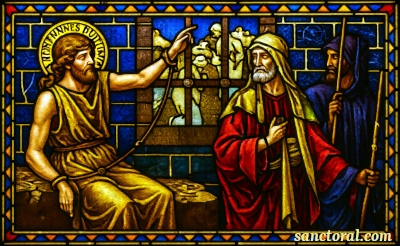
At that time, when John had heard in prison the works of Christ, sending two of his disciples, he said to Him: Art thou He that art to come, or look we for another? And Jesus making answer, said to them: Go and relate to John what you have heard and seen. The blind see, the lame walk, the lepers are cleansed, the deaf hear, the dead rise again, the poor have the gospel preached to them: and blessed is he that shall not be scandalised in Me. And when they went their way, Jesus began to say to the multitudes concerning John: What went you out into the desert to see? A reed shaken with the wind? But what went you out to see? A man clothed in soft garments? Behold they that are clothed in soft garments are in the houses of kings. But what went you out to see? A prophet? Yea I tell you, and more than a prophet. For this is he of whom it is written: Behold I send My angel before Thy face, who shall prepare Thy way before Thee.Reflexion on the Gospel
The Liturgical Year, authored by Dom Prosper Gueranger (1841-1875)