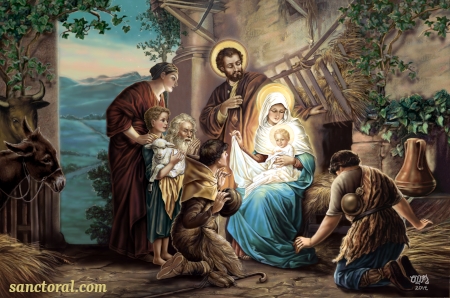
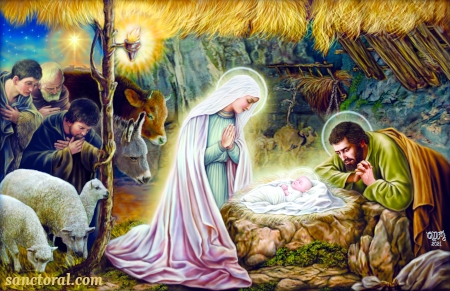
But such is the greatness of to-day’s Mystery, that the Church is not satisfied with only once offering up the Holy Sacrifice. The long-expected and precious Gift deserves an unusual welcome. God the Father has given his Son to us; and it is by the operation of the Holy Ghost that the grand Portent is produced: let there be, then, to the ever Blessed Three, the homage of a triple Sacrifice. Besides, this Jesus, who is born to-night, is born thrice. He is born of the Blessed Virgin, in the stable of Bethlehem; he is born by grace, in the hearts of the Shepherds, who are the first fruits of the Christian Church; and he is born eternally from the Bosom of the Father, in the brightness of the Saints: to this triple Birth, therefore, let there be the homage of a triple Sacrifice. The first Mass honours the Birth according to the Flesh, which, like the other two, is an effusion of the Divine Light. The hour is come: the people that walked in darkness have seen a great Light; Light is risen to them that dwelt in the region of the shadow of death (Is.9). Outside the holy place, where we are now assembled, there is dark Night: material Night, caused by the absence of the sun; spiritual Night, by reason of the sins of men, who either sleep in the forgetfulness of God, or wake to the commission of crime. At Bethlehem, round the Stable, and in the City, all is deep darkness; and the inhabitants, who would not find room for the Divine Babe, are sleeping heavily: will they awaken when the Angels begin to sing? Midnight comes. The Holy Virgin has been longing for this happy moment. Her heart is suddenly overwhelmed with a delight which is new even to her. She falls into an ecstasy of love. As her Child will one day, in his almighty power, rise through the unmoved barrier of his Sepulchre; so now, as a sunbeam gleaming through purest crystal, he is born, and lies on the ground before her. With arms outstretched to embrace her, and smiling upon her: this is her first sight of her Son, who is Son also of the Eternal Father! She adores – takes him into her arms – presses him to her heart – swathes his infant limbs – and lays him down in the manger. Her faithful Joseph unites his adoration with hers; and so, too, do the Angels of heaven, for, the Royal Psalmist had sung this prophecy of their adoring him on his entrance into the world (Ps. 96:7; Heb. 1:6). Heaven opens over this spot of earth, which men call a Stable; and from it there mount to the Throne of the Eternal Father the first prayer, the first tear, the first sob of this his Son, our Jesus, who thus begins to prepare the world’s salvation. The eyes of the faithful are now riveted on the Sanctuary, where the same Jesus is to be their Holy Sacrifice. The procession of the sacred Ministers has entered the Holy of Holies, and the Priest comes with them to the foot of the Altar. The Choir is singing its opening-canticle, the Introit; where we have our God himself speaking to his Son, and saying: This Day have I begotten thee. Let the Nations rage, if they will, and be impatient of the yoke of this Babe of Bethlehem; he shall subdue them and reign over them, for he is the Son of God. (Ps. 2:7 and 1) The Lord hath said to me: Thou art My Son, this day have I begotten Thee. — Psalm. Why have the Gentiles raged, and the people devised vain things? Gloria Patri. O God, who hast made this most holy night to shine forth with the brightness of the true Light: grant, we beseech Thee, that we, who have known the mystery of His light on earth, may attain the enjoyment of His happiness in heaven. Who lives and reigns with Thee in the unity of the Holy Spirit, God, forever and ever. Lesson of the Epistle of Saint Paul the Apostle to Titus (2:11-15) This God our Saviour hath at length appeared! and with such grace and mercy! He alone could deliver us from dead works, and restore us to life. At this very hour, he appeareth to all men, laid in his narrow Crib, and fastly wrapped, as a Babe, in swaddling- clothes. Yes, here have we the Blessed One, whose visit we had so long hoped for! Let us purify our hearts, that he may be pleased with us; for though he is the Infant Jesus, he is also, as the Apostle has just told us, the Great God, and the Son of the Eternal Father, born from all eternity. Let us unite with the Angels and the Church in this hymn to our Great God, Jesus of Bethlehem. (Ps. 109:3 and 1) With Thee is the principality in the day of Thy strength: in the brightness of the Saints, from the womb before the day star I begot Thee. ℣. The Lord said to my Lord: Sit Thou at My right hand, until I make Thy enemies Thy footstool. Alleluia, alleluia. ℣. The Lord hath said to Me: Thou art My Son, this day have I begotten Thee. Alleluia. The Sequel of the holy Gospel according to saint Luke (2:1-14). O Divine Infant! we too must needs join our voices with those of the Angels, and sing with them: Glory be to God! and Peace to men! We cannot restrain our tears at hearing this history of thy Birth. We have followed thee in thy journey from Nazareth to Bethlehem; we have kept close to Mary and Joseph on the whole journey; we have kept sleepless watch during this holy Night, waiting thy coming. Praise be to thee, sweetest Jesus, for thy mercy! and love from all hearts for thy tender love of us! Our eyes are riveted on that dear Crib, for our Salvation is there; and there we recognize thee as the Messias foretold in those sublime Prophecies which thy Spouse the Church has been repeating to us in her solemn prayers of this night. Thou art the mighty God – the Prince of Peace – the Spouse of our souls – our Peace – our Saviour – our Bread of Life. And now what shall we offer thee? A good Will? Ah! dear Lord! thou must form it within us; thou must increase it, if thou hast already given it; that thus, we may become thy Brethren by grace, as we already are by the human nature thou hast assumed. But, O Incarnate Word! this Mystery of thy becoming Man works within us a still higher grace: it makes us, as thy Apostle tells us, partakers of that divine nature [St Pet. i 4] which is inseparable from thee in the midst of all thy humiliations. Thou hast made us less than the Angels in the scale of creation; but in thy Incarnation thou hast made us Heirs of God, and Joint-Heirs [Rom viii 17] with thine own divine Self. Never permit us, through our own weaknesses and sins, to degenerate from this wonderful gift, whereby thy Incarnation exalted us, and oh! dear Jesus, to what a height! After the Gospel, the Church triumphantly chants the glorious symbol of our Faith, which tells, one by one, the Mysteries of the Man-God. At the words: Et Incarnatus est de Spiritu Sancto ex Maria Virgine, ET HOMO FACTUS EST, profoundly adore the great God who assumed our human nature, and became like unto us, his poor creatures; let your adoration and love repay him, if it were possible, for this his incomprehensible abasement. In each of to-day’s Masses, when the Choir comes to these words in the Credo, the Priest rises from the sedilia, and remains kneeling in humble adoration at the foot of the Altar whilst they are being sung. You must unite your adorations with those of the Church, which is represented by the Celebrant. The Office of Lauds is finished: the Canticles of joy wherewith the Church thanks the Eternal Father for his having made to rise upon us the divine Sun of Justice are ended. It is time to offer up the second Sacrifice, or, as it is called, the Mass of the Aurora. In the first, the Church celebrated the temporal Birth of the Word according to the flesh. In this, she is going to honour the second Birth of the same Son of God; a Birth full of grace and mercy; that which is accomplished in the heart of the faithful Christian. See, then, how, at this very hour, Shepherds are told by the Angels to go to Bethlehem, and how they hasten thither. With great eagerness they enter the Stable, which is scarcely large enough to hold them. Obedient to the warning received from heaven, they are come to see the Saviour, who, they have been told, has been born unto them. They find all things just as the Angels had said. Who could tell the joy of their hearts, and the simplicity of their faith? They are not surprised to find, in the midst of poverty greater even than their own, him whose Birth has made the very Angels exult. They find no difficulty in acknowledging the wonderful mystery; they adore, they love, the Babe that lies there before them. They are at once Christians, and the Christian Church begins in them; the mystery of a God humbled for man finds faith in these humble souls. Herod will plot the death of this Babe; the Synagogue will rage; the Scribes and Doctors will league together against the Lord and his Christ; they will put this Saviour of Israel to death; but the faith of the Shepherds will not be shaken, and will find imitators in the wise and powerful ones of this world, who will come at last, and bow down their reason to the Crib and the Cross. What is it that has come over these poor Shepherds? Christ has been born in their hearts; he dwells in them by faith and love. They are our Fathers in the Church. They are our Models. Let us imitate them, and invite the Divine Infant to come into our souls, which we will so prepare for him, that he may find nothing to prevent his entering. It is for our sakes also that the Angels speak; it is to us also that they tell the glad tidings; for the Mystery that has been accomplished this Night is too grand to have the pastoral slopes of Bethlehem for its limits. In order to honour the silent coming of the Saviour into the souls of men, the Priest is preparing to go to the altar, and a second time to offer the spotless Lamb to the Father who hath sent him. As the Shepherds fixed their eyes on the Crib, so let ours be on the Altar, where we are soon to behold the same Jesus, hidden under appearances that are humbler even than the swathing-bands. These rustic swains enter into the Cave, not yet knowing him, whom they are going to see; but their hearts are quite ready for the revelation. Suddenly they see the Infant; and as they gaze upon him in speechless wondering, Jesus looks at them from his Crib, and smiles upon them: they are changed men, full of light, and the Sun of Justice has made Day in their souls. It is to be the same with us: the words of the Prince of the Apostles are to be verified in us: the Light that shineth in a dark place, has been our one desire and attention; now the Day will dawn, and the Day-Star arise in our hearts (II St. Pet. 1:19) . This long longed-for Aurora has come! The divine Orient has risen upon us, to set now no more; for, we are firmly resolved to keep from the night of sin, which his grace has destroyed. His mercy has made us to be children of light and children of the day (I Thes. 5:5).There must be no more sleep of death for us. We must watch in ceaseless vigilance, remembering how the Shepherds were keeping their watch, when the Angel came to speak to them, and Heaven opened over their heads. All the Chants of this Mass of the Aurora speak to us of the brightness of the Sun of Justice; they must be sweet to us, as to captives, long buried in the cold darkness of their dungeon, is the ray of that morning which is to set them free. See, Christians, how this God of Light shines upon us from his Crib! The face of his mother is lit up with the immense brightness, on which she looks with all the fixedness of her contemplating love; and Joseph, too, has the shining vivid on his features, which makes them more beautiful and venerable than we have ever seen them. Passing by the ungrateful Bethlehem, which deserves to be left in darkness, this same divine Light breaks upon the whole world beyond the Cave, and gradually enkindles within millions of hearts a burning love for this glorious Sun of Justice, who delivers man from the labyrinth of his errors and passions, showing him and giving him the sublime end for which he was created. In the very midst of her celebration of this mystery of the Birth of Jesus, the Church offers us another object of admiration and joy: it is one of her own children. Whilst solemnizing the divine Mystery of to-day’s Feast, she commemorates in this second Mass one of those glorious heroines who preserved the Light of Christ within their souls, in spite of all the attacks made to rob them of it. Her name is Anastasia. This holy Widow of Rome suffered martyrdom under the persecution of Diocletian, and had the privilege of being thus born to eternal life on the Birthday of that Jesus for whom she suffered death. She had been married to a Pagan of the name of Publius; himself also a Roman; who, being irritated against her on account of her great charities to the Christians, treated her with every sort of cruelty. She endured all with admirable patience; and when this heavy trial was removed from her by the death of her husband, she devoted herself to visiting and solacing the holy Confessors who had been cast into the prisons of Rome for the Faith. Being at length apprehended as a Christian, she was tied to a stake and burned to death. Her Church in Rome, which is built on the site where formerly stood her house, is the Station for this Second Mass. The Sovereign Pontiffs used formerly to say it here, and the ancient custom was observed in later times by Pope Leo XII. How admirable is this delicate considerateness of our holy Mother the Church! Wishing to associate one of her Saints with the glory of this present Solemnity, on which the Virginity of Mary receives its triumphant recompense, it is a holy Widow that is chosen for this signal honour; that it might hereby be shown how the Married State, though inferior in merit and holiness to the state of Virginity, is not excluded from the blessings which the Birth of the Son of Mary merited for the world. There was a Virgin, St. Eugenia, that might so well have been selected; for she suffered a glorious martyrdom under Galerian on this same feast, and in the same City as did the wife of Publius: but no – the preference is given to Anastasia, the Widow. This choice of the Church, which is dictated by her heavenly wisdom, and by the love she has for all her children, forcibly reminds us of a beautiful passage in one of St. Augustine’s Sermons for Christmas Day. ‘Exult, O ye Virgins of Christ! for the Mother of Christ is your companion. You could not be his Mother; but for his sake you would be Virgins: he that is not born of you, is born to you. And yet you remember his words: Whosoever shall do the will of my Father, is my brother and sister and mother (St. Matth. 12:50). Now have you not done the will of his Father? ‘Exult, O ye Widows of Christ! for ye have vowed a holy continency to him, that made Virginity fruitful. And thou too, O nuptial chastity! you, I mean, that are faithful in the married state, you also may exult; for what you lose in the body, you do not lose in your hearts. … Let your soul be virginal by its faith, for it is by her Faith that the Church is a Virgin. … Jesus is Truth and Peace and Justice; conceive him by your faith, give him birth by your good works; in order that what the womb of Mary did in the Flesh of Jesus, your heart may do in the law of Jesus. Believe me, you yourselves are children of virginity, for are you not the members of Christ? Mary is Mother of Jesus, who is our Head; and the Church is the mother of you who are his members. Yes, the Church is, like Mary, both Mother and Virgin: she is Mother by her tender charity; and Virgin by the purity of her faith and holiness.’ (Ninth Sermon On our Lord’s Nativity) But the Holy Sacrifice is about to commence. The Introit tells us of the Birth of Jesus our Sun of Justice. The brightness of his first rising is the presage of his mid-day splendour. Strength and Beauty are his. He is armed for victory, and his name is Prince of Peace. (Is. 9:2 and 6) A light shall shine upon us this day: for the Lord is born to us: and He shall be called Wonderful, God, the Prince of Peace, the Father of the world to come: of whose reign there shall be no end. — Psalm. The Lord hath reigned, He is clothed with beauty: the Lord is clothed with strength, and hath girded Himself. Gloria Patri. Grant, we beseech Thee, almighty God, that we, upon whom is poured the new light of Thine Incarnate Word, may show forth in our actions that brightness which by faith shineth in our minds. Through the same Jesus Christ, Thy Son, our Lord, Who lives and reigns with Thee in the unity of the Holy Spirit, God, forever and ever. Commemoration of St. Anastasia Lesson of the Epistle of Saint Paul the Apostle to Titus (3:4-7) This Sun which has appeared on our earth is God our Saviour, full of tenderest mercy. We were far off from God, and were sitting in the shades of death; the rays of the divine Light had to reach down to us in the deep abyss of our sins; and now, praise be to this Infinite Mercy! we are set free, and with our freedom have received regeneration, justification, and heirship to eternal life. Who shall henceforth separate us from the love of this Infant Jesus? Is it possible that we ourselves can ever frustrate the designs of that love, by rendering all that it has done for us useless, and becoming once more the slaves of darkness and death? May God forbid it! and grant us grace to maintain our hope of everlasting life, which the Mystery of our Redemption has purchased for us. (Ps. 117:26-27 and 23) Blessed be He that cometh in the name of the Lord: the Lord is God, and He hath shone upon us. This is the Lord’s doing: and it is wonderful in our eyes. Alleluia, alleluia. ℣. The Lord hath reigned, He is clothed with beauty: the Lord is clothed with strength, and hath girded Himself with power. Alleluia. The Sequel of the holy Gospel according to saint Luke (2:15-20). Let us imitate the earnestness of the Shepherds in hastening to Jesus. No sooner do they hear the Angel’s words, than they start for the holy Stable in Bethlehem. Once in the presence of the Divine Infant, they know him by the sign that had been given them by the Angel; and Jesus is born in their souls by his grace. These happy men delight now in their poverty, for they find that he too is poor. They feel that they are united to him for ever, and their whole lives shall testify to the change that this December Night has worked in them. They do not keep the great event to themselves; they tell every one about the Babe of Bethlehem, they become his Apostles, and their burning words fill their listeners with astonishment. Like them, let us glorify the great God, who, not satisfied with calling us to the admirable Light, has set it in the very centre of our hearts by uniting us to himself. Let us often think of the Mysteries of this glorious Night, after the example of Mary, who keeps unceasingly in her most pure Heart the wonderful things that God has been accomplishing by her and in her.Let us imitate the earnestness of the Shepherds in hastening to Jesus. No sooner do they hear the Angel’s words, than they start for the holy Stable in Bethlehem. Once in the presence of the Divine Infant, they know him by the sign that had been given them by the Angel; and Jesus is born in their souls by his grace. These happy men delight now in their poverty, for they find that he too is poor. They feel that they are united to him for ever, and their whole lives shall testify to the change that this December Night has worked in them. They do not keep the great event to themselves; they tell every one about the Babe of Bethlehem, they become his Apostles, and their burning words fill their listeners with astonishment. Like them, let us glorify the great God, who, not satisfied with calling us to the admirable Light, has set it in the very centre of our hearts by uniting us to himself. Let us often think of the Mysteries of this glorious Night, after the example of Mary, who keeps unceasingly in her most pure Heart the wonderful things that God has been accomplishing by her and in her. The Mystery which the Church honours in this Third Mass is the eternal generation or Birth of the Son of God in the Bosom of his Father. At midnight she celebrated the God-Man, born in the Stable from the Womb of the glorious Virgin Mary; at the Aurora, this same Divine Infant, born in the souls of the Shepherds; there still remains for her adoration and praise a Birth more wonderful than these other two: a Birth, which dazzles the eye of Angels by its splendour, and bears its eternal witness to the inward fruitfulness of God. The Son of Mary is also the Son of God; and a grand duty of to-day is that we hymn aloud the glory of this his in effable Generation, which makes him consubstantial to his Father, God of God and Light of Light. Let us, then, raise up our thoughts even to that eternal Word, who was in the beginning with God, and was himself God (St. John 1:1); for he is the brightness of his Father’s glory, and the figure of his substance (Heb. 1:3). The Church’s first Chant in this her Third Mass is an acclamation to the new-born King. She celebrates the kingly power and majesty which he will derive, as Man, from the Cross that is one day to be upon his shoulders; as God, he has been the Almighty King from all eternity, and this too she celebrates. He is also the Angel of the great Counsel; that is, he is the One Sent from heaven to fulfil the sublime Counsel or design of the Most Holy Trinity – to save mankind by the Incarnation and the Redemption. The Second Person of the Blessed Trinity, the Word, made this Counsel, together with the other Two: his devotedness to his Father’s glory, and his love for man, made him take upon himself the execution of the divine Plan. (Is. 9:6) A Child is born to us, and a Son is given to us: Whose government is upon His shoulder and His Name shall be called the Angel of Great Counsel. — (Ps. 97:1). Sing ye to the Lord a new canticle: for He hath done wonderful things. Gloria Patri. Grant, we beseech Thee, almighty God, that the new birth in the flesh of Thine only-begotten Son may set us free, whom the old bondage doth hold under the yoke of sin. Through the same Jesus Christ, Thy Son, our Lord, Who lives and reigns with Thee in the unity of the Holy Spirit, God, forever and ever. Lesson of the Epistle of Saint Paul the Apostle to the Hebrews (1:1-12) The great Apostle, in this magnificent opening of his Epistle to his former brethren of the Synagogue, lays great stress on the Eternal Generation of our Lord Jesus Christ. Whilst our eyes are fixed on the sweet Infant in his Crib, St Paul bids us raise our thoughts up to that infinite Light, from the midst of which the Eternal Father thus speaks to this Child of Mary: Thou art my Son; to-day have I begotten thee: this to-day is the Day of eternity, a Day which has neither morning nor evening, neither rising nor setting. If the Human Nature which he has vouchsafed to assume places him below the Angels; he is infinitely above them by his own essence, whereby he is the Son of God. He is God, he is Lord, and no change can come upon him. He may be wrapped in swathing-bands or nailed to a Cross, or put to a most ignominious death; all this is only in his human nature: in his Divinity he remains impassible and immortal, for he was born of the Father from all eternity. (Ps. 97:3-4 and 2) All the ends of the earth have seen the salvation of our God: sing joyfully to God, all the earth. The Lord hath made known His salvation: He hath revealed His justice in the sight of the Gentiles. Alleluia, alleluia. ℣. A sanctified day hath shown upon us: come, ye Gentiles, and adore the Lord: for this day a great light hath descended upon the earth. Alleluia. The Beginning of the holy Gospel according to saint John (1:1-14). O Eternal Son of God! in presence of the Crib, where for the love of us thou vouchsafest this day to show thyself to thy creatures, we confess thy eternity, thy omnipotence, thy divinity, and most profoundly do we adore thee. Thou wast in the beginning; thou wast in God; and thyself wast God. Everything was made by thee, and we are the work of thy hands. O Light, infinite and eternal! O Sun of Justice! enlighten us, for we are but darkness. Too long have we loved our darkness, and thee we have not comprehended: forgive us our blindness and our errors. Thou hast been long knocking at the door of our hearts, and we have refused to let thee in. To-day, thanks to the wonderful ways of thy love, we have received thee: for who could refuse to receive thee, sweet gentle Infant Jesus! but leave us not; abide with us, and perfect the New Birth which thou hast begun in us. We wish henceforth to be neither of blood, nor of the will of the flesh, nor of the will of man, but of God, by thee and in thee. Thou hast been made Flesh, O Word Eternal! in order that we may become sons of God. We beseech thee, support our weak human nature, and fit us for this our sublime destiny. Thou art born of God thy Father; thou art born of Mary; thou art born in our hearts; thrice glorified be thou for this thy triple Birth, O Jesus! so merciful in thy Divinity, and so divine in thy self-sought humiliations! Sources: Daily Traditional Latin Mass Readings, 1962The Nativity of Our Lord Jesus Christ
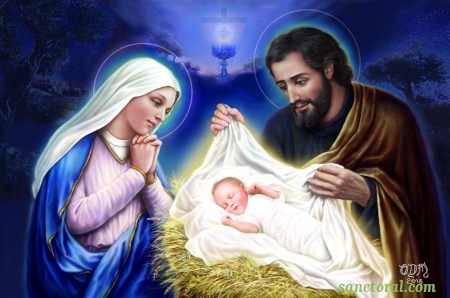
Table of Contents
Considerations
Midnight Mass
Introit
Collect
Epistle
Dearly beloved: The grace of God our Savior hath appeared to all men, instructing us, that, denying ungodliness and worldly desires, we should live soberly and justly and godly in this world, looking for the blessed hope and coming of the glory of the great God and our Savior Jesus Christ: Who gave Himself for us, that He might redeem us from all iniquity, and might cleanse to Himself a people acceptable, a pursuer of good works. These things speak and exhort: in Christ Jesus our Lord.Reflexion on the Epistle
Gradual
Gospel
At that time there went out a decree from Cæsar Augustus, that the whole world should be enrolled. This enrolling was first made by Cyrinus, the governor of Syria. And all went to be enrolled, every one into his own city. And Joseph also went up from Galilee out of the city of Nazareth, into Judea to the city of David, which is called Bethlehem: because he was of the house and family of David, to be enrolled with Mary his espoused wife, who was with child. And it came to pass, that when they were there, her days were accomplished that she should be delivered. And she brought forth her first-born Son, and wrapped Him up in swaddling clothes, and laid Him in a manger: because there was no room for them in the inn. And there were in the same country shepherds watching and keeping the night watches over their flock. And behold an Angel of the Lord stood by them, and the brightness of God shone round about them, and they feared with a great fear. And the Angel said to them: Fear not; for behold I bring you good tidings of great joy, that shall be to all the people: for this day is born to you a Savior, who is Christ the Lord, in the city of David. And this shall be a sign unto you: you shall find the Infant wrapped in swaddling clothes, and laid in a manger. And suddenly there was with the Angel a multitude of the heavenly army, praising God, and saying: Glory to God in the highest, and on earth peace to men of good will.Reflexion on the Gospel
Mass at Dawn
Considerations
Introit
Collect
Grant, we beseech Thee, O almighty God, that we who honor the solemnity of Thy blessed martyr, Anastasia, may experience the effect of her intercession with Thee. Through our Lord Jesus Christ, Thy Son, Who lives and reigns with Thee in the unity of the Holy Spirit, God, forever and ever.Epistle
Dearly beloved, the goodness and kindness of God our Savior appeared: not by the works of justice which we have done, but according to His mercy He saved us by the laver of regeneration and renovation of the Holy Ghost, whom He hath poured forth upon us abundantly through Jesus Christ our Savior: that, being justified by His grace, we may be heirs according to hope of life everlasting: in Christ Jesus our Lord.Reflexion on the Epistle
Gradual
Gospel
At that time the shepherds said one to another: Let us go over to Bethlehem, and let us see this word that is come to pass, which the Lord hath showed to us. And they came with haste: and they found Mary and Joseph, and the Infant lying in the manger. And seeing they understood of the word that had been spoken to them concerning this Child. And all that heard wondered: and at those things that were told them by the shepherds. But Mary kept all these words, pondering them in her heart. And the shepherds returned, glorifying and praising God for all the things they had heard and seen, as it was told unto them.Reflexion on the Gospel
Mass during the Day
Considerations
Introit
Collect
Epistle
God, Who at sundry times and in divers manners spoke in times past to the fathers by the prophets, last of all in these days has spoken to us by His Son, Whom He appointed heir of all things, by Whom also He made the world; Who, being the brightness of His glory and the image of His substance, and upholding all things by the word of His power, has effected man’s purgation from sin and taken His seat at the right hand of the Majesty on high, having become so much superior to the angels as He has inherited a more excellent name than they. For to which of the angels has He ever said, You are My Son, I this day have begotten You? and again, I will be to Him a Father, and He shall be to Me a Son? And again, when He brings the firstborn into the world, He says, And let all the angels of God adore Him. And of the angels indeed He says, He makes His angels spirits, and His ministers a flame of fire. But of the Son, Your throne, O God, is forever and ever, and a sceptre of equity is the sceptre of Your kingdom. You have loved justice and hated iniquity; therefore God, Your God, has anointed You with the oil of gladness above Your fellows. And, You in the beginning, O Lord, did found the earth, and the heavens are works of Your hands. They shall perish, but You shall continue; and they shall all grow old as does a garment, and as a vesture shall You change them, and they shall be changed. But You are the same, and Your years shall not fail.Reflexion on the Epistle
Gradual
Gospel
In the beginning was the Word, and the Word was with God; and the Word was God. He was in the beginning with God. All things were made through Him, and without Him was made nothing that has been made. In Him was life, and the life was the light of men. And the light shines in the darkness; and the darkness grasped it not. There was a man, one sent from God, whose name was John. This man came as a witness, to bear witness concerning the light, that all might believe through him. He was not himself the light, but was to bear witness to the light. It was the true light that enlightens every man who comes into the world. He was in the world, and the world was made through Him, and the world knew Him not. He came unto His own, and His own received Him not. But to as many as received Him He gave the power of becoming sons of God; to those who believe in His name: who were born not of blood, nor of the will of the flesh, nor of the will of man, but of God. And the Word was made flesh (Genuflect), and dwelt among us. And we saw His glory - glory as of the Only-begotten of the Father - full of grace and of truth.Reflexion on the Gospel
The Liturgical Year, authored by Dom Prosper Gueranger (1841-1875)