"Our Saviour was invited to the wedding feast at Cana,” says St. Augustine, "and He went there to reveal to us the mystery typified by this wedding, that is, the union of Christ with His Church” (Matins, 3rd nocturn). All the Fathers regarded the miracle of Cana not only as a confirmation of His mission but as symbolizing the Eucharist wherein Jesus changes the wine into His Blood, and through the Eucharist typifying that covenant of Christ with our souls, sealed by His Blood on the Cross, which finds its consummation in our souls in holy Communion. That is the wedding feast on earth which is a preparation for the eternal nuptials of heaven. We were water, Christ has turned us into wine: our transformation, our sanctification by union with Him, is the purpose of the Incarnation of Christ and the marvellous effect which it realizes in our souls. The conversion of water into wine, says St Thomas, is a symbol of transubstantiation, the greatest of all miracles, whereby the wine of the Eucharist becomes the blood of the covenant of peace which God has made with His Church'. (Saint Andrew Daily Missal with Vespers for Sundays and Feasts, by Dom Gaspar Lefebvre, O.S.B. of the Abbey of St. André, 1953) (Ps. 65:4) Let all the earth adore Thee, O God, and sing to Thee: let it sing a psalm to Thy name, O Most High. — (Ps. 65:1-2). Shout with joy to God, all the earth, sing ye a psalm to His name: give glory to His praise. Gloria Patri. Almighty and everlasting God who dost govern all things in heaven and earth, mercifully hear the prayers of Thy people, and grant us Thy peace in our times. Through our Lord Jesus Christ, Thy Son, Who lives and reigns with Thee in the unity of the Holy Spirit, God, forever and ever. Reading of the Epistle of the blessed Apostle Paul to the Romans (12:6-16) (Ps. 106:20-21) The Lord sent His word, and healed them: and delivered them from their destruction. ℣. Let the mercies of the Lord give glory to Him: and His wonderful works to the children of men. Sources: Daily Traditional Latin Mass Readings, 1962Sunday after Epiphany - The wedding feast at Cana
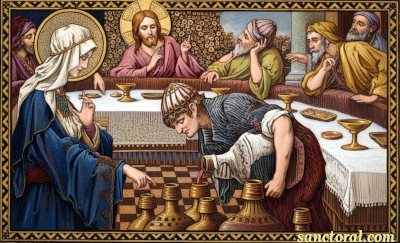
Table of Contents
Reflexions on the Liturgy of the Day
Liturgy of the Mass
Introit
Collect
Epistle
Brethren: Having different gifts, according to the grace that is given us: either prophecy, to be used according to the rule of faith; or ministry, in ministering; or he that teaches, in doctrine; he that exhorts, in exhorting; he that gives, with simplicity; he that rules, with carefulness; he that shows mercy, with cheerfulness. Let love be without dissimulation. Hating that which is evil, cleaving to that which is good: loving one another with the charity of brotherhood, with honor preventing one another: in carefulness not slothful: in spirit fervent: serving the Lord: rejoicing in hope: patient in tribulation: instant in prayer: communicating to the necessities of the saints: pursuing hospitality. Bless them that persecute you: bless, and curse not. Rejoice with them that rejoice, weep with them that weep: being of one mind one towards another; not minding high things, but consenting to the humble.Gradual
Alleluia, alleluia. ℣. (Psalms 148:2) Praise ye the Lord, all His Angels: praise ye Him, all His hosts. Alleluia.Gospel
The Sequel of the holy Gospel according to saint John (2:1-11).
At that time there was a marriage in Cana of Galilee: and the mother of Jesus was there. And Jesus also was invited, and His disciples, to the marriage. And the wine failing, the mother of Jesus saith to Him: They have no wine. And Jesus saith to her: Woman, what is that to Me and to thee? My hour is not yet come. His mother saith to the waiters: Whatsoever He shall say to you, do ye. Now there were set there six water pots of stone, according to the manner of the purifying of the Jews, containing two or three measures apiece. Jesus saith to them: Fill the water-pots with water. And they filled them up to the brim. And Jesus saith to them: Draw out now, and carry to the chief steward of the feast. And they carried it. And when the chief steward had tasted the water made wine, and knew not whence it was, but the waiters knew who had drawn the water: the chief steward calls the bridegroom, and saith to him: Every man at first sets forth good wine: and when men have well drunk, then that which is worse: but thou hast kept the good wine until now. This beginning of miracles did Jesus in Cana of Galilee; and manifested His glory, and His disciples believed in Him.
Saint Andrew Daily Missal with Vespers for Sundays and Feasts, by Dom Gaspar Lefebvre, O.S.B. of the Abbey of St. André, 1953)