God, desiring to form His own special people among all the idolatrous nations, chose Abraham for its head and called him by this name which means father of many nations... “He took him from Ur in Chaldee and preserved him from harm in all his wanderings." By faith, says the Epistle to the Hebrews, Abraham, when the call came, "obeyed and went into a place which he was to receive for an inheritance. And he went out not knowing whither he went.” By faith he obtained the land of Canaan where he lived for more than twenty years as a stranger. By faith, in his old age, he became the father of Isaac and did not hesitate, at God’s command, to offer him in sacrifice in spite of the fact that he was his only son in whom was all his hope for the fulfilment of God’s promises of an innumerable posterity. God, he told himself, was powerful enough to raise up his son from the dead. And in a figurative sense he did so recover him. Isaac, indeed, was a type of Christ when he was chosen to be "the most glorious victim of his father,” when he bore the wood on which he was to be sacrificed as our Lord carried the Cross on which He merited glory through His Passion; Isaac was especially a type of Christ when he was miraculously delivered from death, and was in some sort restored to life to proclaim that Christ, having been put to death, should rise again. Thus by his faith Abraham, who believed unhesitatingly what was to happen, saw from afar our Lord’s triumph on the Cross; he saw and rejoiced.lt was then that God confirmed His promises: “Because thou hast not spared thy only begotten son for my sake: I will bless thee and I will multiply thy seed as the stars of heaven, andas the sand that is by the seashore.” These promises were fulfilled by Christ in His Passion. “Christ hath redeemed us,” says St. Paul, (for it is written, cursed is everyone that hangeth on a tree) that the blessing of Abraham might come on the Gentiles through Christ Jesus; that we may receive the promise of the Spirit by faith1,” that is the spirit of adoption which was promised to us. For this reason the Collect after theProphecy about Abraham on Holy Saturday addresses God as “the supreme Father of all the faithful, who over all the world multipliest the children of Thy promise by diffusing the grace of Thy adoption: and by this Paschal sacrament makest Thy servant Abraham, according to Thy oath, the father of all nations.” In reality it is by baptism (formerly administered at Easter and Whitsun) that having been made children of Abraham we enter on the inheritance promised to us, that is, the Church, or the heavenly Jerusalem, typified bythePromised Land. Faith in Christ, who died and rose again, by which Abraham merited to become the father of all nations and which enables us to become his children, is the subject of the Gospel. In it Christ foretells His Passion and His final victory and restores the sight of a blind man telling him: “Thy faith hath saved thee.” St. Gregory’s commentary on this incident is that the blind man recovered his sight under the very eyes of the Apostles “so that to have witnessed deeds wrought by the divine power might strengthen the faith of those who could not yet grasp the message that a heavenly mystery was revealed to the world. Indeed it was necessary that when later they should see our Lord die in the very way foretold by Him, they should have no doubt at all that He must also rise from the dead.” In its turn the Epistle brings out all the merit of Abraham’s faith, a faith animated entirely by charity, as ours should be; a faith which for love of God, carries out His behests, rusting in His promises even when His secret designs are hidden from us. A man is not saved by being a son of Abraham according to the flesh but by being Abraham’s son through faith like his. So St. Paul writes: “In Christ Jesus neither circumcision (i.e. to be a Jew) availeth anything, nor uncircumcision (i.e. to be a Gentile) but faith that worketh by charity.” (Ps. 30:3-4) Be Thou unto me a God, a Protector, and a place of refuge, to save me; for Thou art my strength and my refuge: and for Thy Name's sake Thou wilt lead me, and nourish me. (Ps. 30:2) In Thee, O Lord, have I hoped, let me never be confounded: deliver me in Thy justice, and save me. Gloria Patri. Do Thou, we beseech Thee, O Lord mercifully hear our prayers, that we being loosed from the bonds of our sins, may by Thee be defended against all adversity. Through our Lord Jesus Christ, Thy Son, Who lives and reigns with Thee in the unity of the Holy Spirit, God, forever and ever. Lesson of the Epistle of Saint Paul the Apostle to the Corinthians (I Cor. 13:1-13) (Ps. 76:15-16) Thou art God that alone doest wonders: Thou has made Thy power known among the nations. ℣. With Thy arm Thou hast delivered Thy people, the children of Israel and of Joseph. (Ps. 99:1-2) Sing joyfully to God, all the earth: serve ye the Lord with gladness. Come in before His presence with exceeding great joy: know ye that the Lord He is God. He made us, and not we ourselves: but we are His people and the sheep of His pasture. The Sequel of the holy Gospel according to saint Luke (18:31-43). Sources: Daily Traditional Latin Mass Readings, 1962Quinquagesima Sunday
Reflexions on the Liturgy of the Day
Liturgy of the Mass
Introit
Collect
Epistle
Brethren: If I speak with the tongues of men and of angels, and have not charity, I am become as sounding brass or a tinkling cymbal. And if I should have prophecy, and should know all mysteries, and all knowledge; and if I should have all faith so that I could remove mountains, and have not charity, I am nothing. And if I should distribute all my goods to feed the poor, and if I should deliver my body to be burned and have not charity, it profiteth me nothing; Charity envieth not, dealeth not perversely, is not puffed up, is not ambitious, seeketh not her own, is not provoked to anger, thinketh no evil, rejoiceth not in iniquity, but rejoiceth with the truth: beareth all things, believeth all things, hopeth all things, endureth all things. Charity never falleth away; whether prophecies shall be made void, or tongues shall cease, or knowledge shall be destroyed. For we know in part, and we prophesy in part. But when that which is perfect is come, that which is in part shall be done away. When I was a child, I spoke as a child, I understood as a child, I thought as a child. But when I became a man, I put away the things of a child. We see now through a glass in a dark manner; but then face to face. Now I know in part; but then I shall know even as I am known. And now there remain faith, hope, and charity, these three; but the greatest of these is charity.Gradual
Tract
Gospel
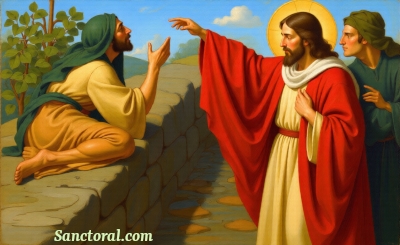
At that time Jesus took unto Him the twelve and said to them: Behold, we go up to Jerusalem, and all things shall be accomplished which were written by the Prophets concerning the Son of Man. For He shall be delivered to the Gentiles, and shall be mocked and scourged and spit upon: and after they have scourged Him, they will put Him to death, and the third day He shall rise again. And they understood none of these things, and the word was hid from them, and they understood not the things that were said. Now it came to pass, when He drew nigh to Jericho, that a certain blind man sat by the wayside begging. And when he heard the multitude passing by, he asked what this meant. And they told him that Jesus of Nazareth was passing by. And he cried out, saying: Jesus, son of David, have mercy on me. And they that went before rebuked him, that he should hold his peace. But he cried out much more: Son of David, have mercy on me. And Jesus standing, commanded him to brought unto him. And when he was come near, He asked him, saying: What wilt thou that I do to thee? But he said: Lord, that I may see. And Jesus said to him: Receive thy sight, thy faith hath made thee whole. And immediately he saw and followed Him, glorifying God. And all the people, when they saw it, gave praise to God.
Saint Andrew Daily Missal with Vespers for Sundays and Feasts, by Dom Gaspar Lefebvre, O.S.B. of the Abbey of St. André, 1953)