Jesus was about to pass from Galilee into Judea, that he might go up to Jerusalem and be present at the Feast of the Pasch. It was that last Pasch, which was to begin with the immolation of the figurative lamb, and end with the sacrifice of the Lamb of God, who taketh away the sins of the world. Jesus would have his disciples know him. His works had borne testimony to him, even to those who were, in a manner, strangers to him; but as for his Disciples, had they not every reason to be faithful to him, even to death? Had they not listened to his words, which had such power with them that they forced conviction? Had they not experienced his love, which it was impossible to resist? and had they not seen how patiently he had borne with their strange and untoward ways? Yes, they must have known him. They had heard one of their company, Peter, declare that he was the Christ, the Son of the Living God. Notwithstanding this, the trial to which their faith was soon to be put, was to be of such a terrible kind that Jesus would mercifully arm them against temptation by an extraordinary grace. The Cross was to be a scandal and stumbling block to the Synagogue, and alas! to more than it. Jesus said to his Apostles, at the Last Supper: All of you shall be scandalized in me this night. Carnal-minded as they then were, what would they think, when they should see him seized by armed men, handcuffed, hurried from one tribunal to another, and he doing nothing to defend himself! And then they found that the High Priests and Pharisees, who had hitherto been so often foiled by the wisdom and miracles of Jesus, had now succeeded in their conspiracy against him—what a shock to their confidence! But there was to be something more trying still: the people who, but a few days before, greeted him so enthusiastically with their hosannas, would demand his execution, and he would have to die between two thieves on the Cross, amidst the insults of his triumphant enemies. Is it not to be feared that these Disciples of his, when they witness his humiliations and sufferings, will lose their courage? They have lived in his company for three years; but when they see that the things he foretold would happen to him are really fulfilled, will the remembrance of all they have seen and heard keep them loyal to him? or will they turn cowards and flee from him?—Jesus selects three out of the number who are especially dear to him: Peter, whom he has made the Rock, on which his Church is to be built, and to whom he has promised the Keys of the kingdom of heaven; James, the son of Thunder, who is to be the first Martyr of the Apostolic College; and John, James’ brother, and his own Beloved Disciple. Jesus has resolved to take them aside, and show them a glimpse of that glory which, until the day fixed for its manifestation, he conceals from the eyes of mortals. He therefore leaves the rest of his Disciples in the plain near Nazareth, and goes, in company with the three privileged ones, towards a high hill called Thabor, which is a continuation of Libanus, and which the Psalmist tells us was to rejoice in the Name of the Lord. No sooner has he reached the summit of the mountain, than the three Apostles observe a sudden change come over him; his Face shines as the sun, and his humble garments become white as snow. They observe two venerable men approach, and speak with him upon what he was about to suffer in Jerusalem. One is Moses, the lawgiver; the other is Elias, the Prophet, who was taken up from earth on a fiery chariot, without having passed through the gates of death. These two great representatives of the Jewish Religion, the Law and the Prophets, humbly adore Jesus of Nazareth. The three Apostles are not only dazzled by the brightness which comes from their Divine Master; but they are filled with such a rapture of delight that they cannot bear the thought of leaving the place. Peter proposes to remain there forever, and build three tabernacles, for Jesus, Moses and Elias. And while they are admiring the glorious sight, and gazing on the beauty of their Jesus’ human Nature, a bright cloud overshadows them, and a voice is heard speaking to them: it is the voice of the Eternal Father, proclaiming the Divinity of Jesus, and saying: This is my beloved Son! This transfiguration of the Son of Man, this manifestation of his glory, lasted but a few moments; his mission was not on Thabor; it was humiliation and suffering in Jerusalem. He therefore withdrew into himself the brightness he had allowed to transpire; and when he came to the three Apostles, who, on hearing the voice from the cloud, had fallen on their faces with fear—they could see no one save only Jesus. The bright cloud was gone; Moses and Elias had disappeared. What a favor they have had bestowed upon them! Will they remember what they have seen and heard? They have had such a revelation of the Divinity of their dear Master!—is it possible than when the hour of trial comes, they will forget it and doubt his being God? and when they see him suffer and die, be ashamed of him and deny him? Alas! the Gospel has told us what happened to them. A short time after this, our Lord celebrated his Last Supper with his Disciples. When the Supper was over, he took them to another mount, Mount Olivet, which lies to the east of Jerusalem. Leaving the rest at the entrance of the Garden, he advances with Peter, James, and John, and then says to them: My soul is sorrowful even unto death: stay you here, and watch with me. He then retires some little distance from them and prays to his Eternal Father. The Hear of our Redeemer is weighed down with anguish. When he returns to his three Disciples, he is enfeebled by the Agony he has suffered, and his garments are saturated with Blood. The Apostles are aware that he is sad even unto death, and that the hour is close at hand when he is to be attacked: are they keeping watch? are they ready to defend him? No: they seem to have forgotten him; they are fast asleep, for their eyes are heavy. Yet a few moments, and all will have fled from him; and Peter, the bravest of them all, will be taking his oath that he never knew the Man. After the Resurrection, our three Apostles made ample atonement for this cowardly and sinful conduct, and acknowledged the mercy wherewith Jesus had sought to fortify them against temptation, by showing them his glory on Thabor, a few days before his Passion. Let us not wait till we have betrayed him: let us at once acknowledge that he is our Lord and our God. We are soon to be keeping the anniversary of his Sacrifice; like the Apostles, we are to see him humbled by his enemies and bearing, in our stead, the chastisements of Divine Justice. We must not allow our faith to be weakened, when we behold the fulfillment of those prophecies of David and Elias, that the Messias is to be treated as a worm of the earth, and be covered with wounds, so as to become like a leper, the most abject of men, and the Man of sorrows. We must remember the grand things of Thabor, and the adorations paid him by Moses and Elias, and the bright cloud, and the voice of the Eternal Father. The more we see him humbled, the more must we proclaim his glory and divinity; we must join our acclamations with those of the Angels and the Four-and-Twenty Elders, whom St. John (one of the witnesses of the Transfiguration) heard crying out with a loud voice: The Lamb that was slain, is worthy to receive power, and divinity, and wisdom, and strength, and honor, and glory, and benediction! The Station at Rome is in the Church of St. Mary in Dominica on Monte Celio. Tradition tells us that in this Basilica was the Diaconicum of which St. Laurence had charge, and from which he distributed to the poor the alms of the Church. Reading from the Epistle of the Apostle St. Paul to the Thessalonians (I Thess. 4:1-7) Here the Apostle shows what manner of life should be followed by Christians; and the Church, by repeating his words, exhorts the Faithful to profit of the present Season of grace, and regain all the beauty of the image of God, which the grace of Baptism first gave them. A Christian is a vessel of honor, formed and enriched by the hand of God; let him, therefore, shun whatsoever would degrade his noble origin, and turn him into a vessel of dishonor, fit only to be broken and cast with the unclean into the sink of hell. The Christian Religion has so far ennobled man that even his very body may share in the soul’s sanctity; on the other hand, she teaches us that this sanctity of the soul is impaired, yea, altogether effaced, by the loss of the body’s purity. The whole man, therefore, both body and soul, is to be reformed by the practices of this holy Season. Let us purify the soul by the confession of our sins, by compunction of heart, by the love of God; and let us give back its dignity to the Body, by making it bear the yoke of penance, that so it may be, henceforth, subservient and docile to the Soul, and, on the day of the general Resurrection, partake in her endless bliss. The Sequel of the holy Gospel according to saint Matthew (17:1-9). Thus did Jesus encourage his Apostles, when the time of temptation was near; he sought to impress them with his glory, that it might keep up their faith in that trying time when the outward eye would see nothing in his person but weakness and humiliation. Oh! the loving considerateness of divine grace, which is never wanting, and shows us, in so strong a light, the goodness and the justice of our God! Like the Apostles, we also have sinned; like them, we have neglected to profit of the help that was sent us from heaven; we have shut our eyes against the light; we have forgotten the fair vision that was granted us, and which made us so fervent and happy—and we fell. We have not, then, been tempted above our strength, and it is indeed our own fault that we committed sin. The three Apostles were exposed to a terrible temptation, when they beheld their Divine Master robbed of all his majesty; but how easy for them to resist the temptation, by thinking of what they had seen but a few days before? Instead of that, they lost their courage, and forgot prayer, which would have brought their courage back; and thus, the favored witnesses of Thabor became cowards and deserters n the Garden of Mount Olivet. There was but one thing left them to do—throw themselves upon the loving mercy of their Jesus, as soon as he had triumphed over his enemies; they did so, and his generous Heart pardoned them. Let us imitate them here too. We have abused the grace of God and rendered it fruitless by our want of correspondence. The fountain of this Grace is not yet dried up; as long as we are in this world, we may always draw from this source, which comes from the Blood and merits of our Redeemer. It is Grace that is now urging us to the amendment of our lives. It is given to us in abundance during the present time, and it is given mainly by the holy exercises of Lent. Let us go up the mountain with Jesus; there, we shall not be disturbed by the noise of earthly things. Let us there spend our forty days with Moses and Elias, who, long before us, sanctified this number by their fasts. Thus, then the Son of Man shall have risen from the dead, we will proclaim the favors he has mercifully granted us on Thabor. Sources: Daily Traditional Latin Mass Readings, 1962Second Sunday of Lent - Transfiguration of Our Lord Jesus Christ
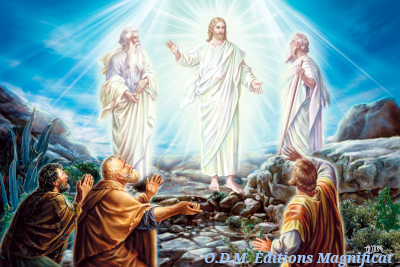
Table of Contents
Reflexions on the Liturgy of the Day
Liturgy of the Mass
Introit
(Ps. 24:6, 3, 22) Remember, O Lord, Thy bowels of compassion, and Thy mercies that are from the beginning of the world, lest at any time our enemies rule over us: deliver us, O God of Israel, from all our tribulations. — (Ps. 24:1-2) To Thee, O Lord, have I lifted up my soul: in Thee, O my God, I put my trust: let me not be ashamed. Gloria Patri.Collect
O God, Who seest that we have no power whatever from ourselves, keep us both outwardly in our bodies and inwardly in our souls; that we may be defended from all adversities which may happen to the body and from all evil thoughts which may hurt the soul. Through our Lord, Jesus Christ, Thy Son, Who lives and reigns with Thee in the unity of the Holy Spirit, God, forever and ever.Epistle
Brethren: We pray and beseech you in the Lord Jesus that, as you have received from us, how you ought to walk and to please God, so also you would walk, that you may abound the more. For you know what precepts I have given to you by the Lord Jesus. For this is the will of God, your sanctification: that you should abstain from fornication, that every one of you should know how to possess his vessel in sanctification and honor; not in the passion of lust, like the Gentiles that know not God: and that no man overreach nor circumvent his brother in business: because the Lord is the avenger of all these things, as we have told you before and have testified. For God hath not called us unto uncleanness, but unto sanctification: in Christ Jesus our Lord.Reflexion on the Epistle
Gradual
(Ps. 24:17-18) ℣. The troubles of my heart are multiplied: deliver me from my necessities, O Lord. ℣. See my abjection and my labor, and forgive me all my sins.Tract
(Ps. 105:1-4) Give glory to the Lord, for He is good: for His mercy endureth for ever. ℣. Who shall declare the powers of the Lord: who shall set forth all His praises? ℣. Blessed are they that keep judgment and do justice at all times. ℣. Remember us, O Lord, in the favor of Thy people; visit us with Thy salvation.
Gospel
At that time Jesus took Peter and James, and John his brother, and bringeth them up into a high mountain apart: and He was transfigured before them. And his face did shine as the sun: and His garments became white as snow. And behold there appeared to them Moses and Elias talking with Him. And Peter answering, said to Jesus: Lord, it is good for us to be here: if Thou wilt, let us make here three tabernacles, one for Thee, and one for Moses, and one for Elias. And as he was yet speaking, behold a bright cloud overshadowed them. And lo, a voice out of the cloud, saying: This is My beloved Son, in Whom I am well pleased: hear ye Him. And the disciples hearing, fell upon their face and were very much afraid. And Jesus came and touched them, and said to them: Arise, and fear not. And they lifting up their eyes saw no one, but only Jesus. And as they came down from the mountain, Jesus charged them, saying: Tell the vision to no man till the Son of Man be risen from the dead.Reflexion on the Gospel
_The Liturgical Year, by Dom Prosper Guéranger.